Awaiting pharmacist review. This page reports clinical trial results, and a licensed Canadian pharmacist has not read it yet. The sources for each number are listed at the foot of the page. It is not a basis for a treatment decision.
What is retatrutide? It is an experimental obesity drug from Eli Lilly and Company, given as a once-weekly injection under the skin. Its claim to attention is the number three. Semaglutide acts on one hormone receptor and tirzepatide on two. Retatrutide acts on three, and in its largest trial people on the top dose lost about a quarter of their body weight on average. It is not approved in any country.
Retatrutide at a glance
| Generic name | Retatrutide |
|---|---|
| Development code | LY3437943 |
| Brand name | None announced |
| Maker | Eli Lilly and Company |
| Type of drug | Peptide; triple hormone receptor agonist |
| How it is taken | Once-weekly injection under the skin |
| Doses in phase 3 | 4, 9 and 12 mg |
| Approved anywhere | No |
| Status in Canada | No submission under review |
How retatrutide works: three receptors, not one
Your gut and pancreas release hormones after you eat. They tell the brain you are full, tell the pancreas to release insulin, and adjust how the body handles fuel. The injectable obesity drugs of the past decade are copies of those hormones, built to last a week where the natural ones last minutes.
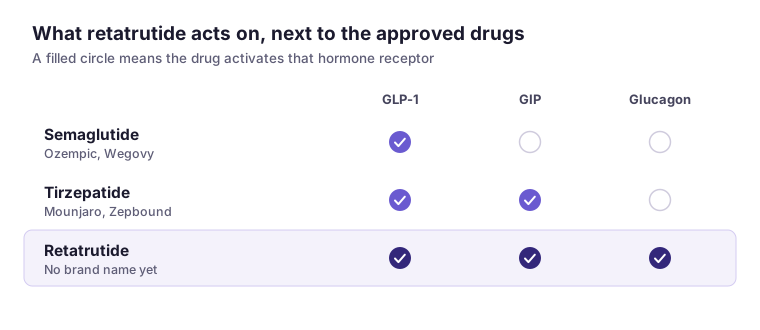
The journal papers describe retatrutide as an agonist of three receptors. An agonist is a molecule that switches a receptor on. Let's break it down.
- GLP-1. The receptor semaglutide targets. Switching it on lowers appetite and slows how fast the stomach empties.
- GIP. A second gut hormone that works alongside GLP-1 on insulin release. Tirzepatide added this one.
- Glucagon. The new addition. Glucagon is best known for raising blood sugar between meals. Researchers think that, paired with the other two, it may also raise the amount of energy the body burns.
A word of caution on that last bullet. The idea that glucagon adds calorie burning is a hypothesis the trials were designed around. The trials measured weight, not which receptor did the work. So "three is better than two" is still an inference from the results, and the head-to-head trial that would test it has not reported.
Retatrutide vs semaglutide and tirzepatide
Think of it as three generations of one idea.
- Semaglutide is sold as Ozempic and Wegovy. One receptor. Health Canada authorized Wegovy for weight management in 2021.
- Tirzepatide is sold as Mounjaro and Zepbound. Two receptors. Eli Lilly Canada announced Zepbound as approved and available here in July 2025.
- Retatrutide has no brand name. Three receptors. Not approved.
All three are weekly injections, and two of them come from the same company. What nobody has yet is a finished trial that puts retatrutide next to either of the others. TRIUMPH-5 compares it with tirzepatide in 800 adults with obesity. The registry estimates its main data collection ends in November 2026. Until then, any ranking you read is a comparison across different trials, and those mislead more often than they inform.
Is retatrutide a peptide?
Yes, a single chain of amino acids with a fatty-acid chain attached, which is also why it has to be injected. The word means something else on shop websites, too. Our page on the retatrutide peptide covers the molecule and that second meaning.
What the retatrutide trials found
The phase 3 programme is called TRIUMPH. Four of its trials have reported, and they cover 5,885 adults between them. Here is the 12 mg result from each.
| Trial | Who was in it | Weeks | Weight loss, 12 mg | Placebo | Basis |
|---|---|---|---|---|---|
| TRIUMPH-1 | Adults with obesity and no diabetes | 80 | 25.0% | 3.9% | Journal, everyone randomized |
| TRIUMPH-2 | Adults with type 2 diabetes and a BMI of 27 or higher | 80 | 18.8% | 5.1% | Journal, everyone randomized |
| TRIUMPH-3 | Adults with a BMI of 35 or higher and established cardiovascular disease | 80 | 22.6% | 3.2% | Lilly topline |
| TRIUMPH-4 | Adults with obesity or overweight and knee osteoarthritis | 68 | 23.7% | 4.6% | Lilly, everyone randomized |
Before phase 3 there was a 48-week phase 2 trial in 338 adults, published in the New England Journal of Medicine in 2023. It is the study that put retatrutide on the map: 24.2% average weight loss at 48 weeks on 12 mg, against 2.1% on placebo.
Notice that people with type 2 diabetes lost less. That is a familiar pattern with these drugs, and it showed up here too.
What retatrutide did for blood sugar
TRIUMPH-2 also tracked HbA1c, the standard three-month measure of blood sugar. In Lilly's topline results it fell by 1.4 to 1.6 percentage points across the three doses over 80 weeks, against 0.2 on placebo. That figure comes from the company's release. The Lancet abstract confirms an improvement without giving the number.
Why you will see two numbers for the same retatrutide trial
Lilly's release for TRIUMPH-1 said 28.3%. The journal paper says 25.0%. Neither is a mistake. They answer different questions.
- The journal's number counts everyone who was randomized, including people who quit the injections early. It answers: what happens to a group of people who are prescribed this?
- The company's headline number estimates the effect if people stay on treatment. It answers: what happens to someone who takes it as planned?
TRIUMPH-4 shows both side by side in Lilly's own documentation: 28.7% if treatment is continued, 23.7% counting everyone. This site leads with the everyone-randomized number where one has been published, because it is the one that survives contact with real life. People stop medications.
Who was in the retatrutide trials
A result only tells you about people like the ones who were studied. So who were they?
- The phase 2 trial. A BMI of 30 or higher, or a BMI of 27 to under 30 with at least one weight-related condition.
- TRIUMPH-2. A BMI of 27 or higher with type 2 diabetes, on stable diabetes treatment, and at least one past attempt to lose weight through diet. The average participant was 55 years old with a BMI of 38.
- TRIUMPH-3. A BMI of 35 or higher with established cardiovascular disease.
That is a picture of obesity with health consequences attached. It is not a picture of someone hoping to lose a few kilos before summer, and the trials say nothing about what the drug does in that person.
How the retatrutide trials were run
The phase 3 trials were randomized and placebo-controlled, and the two published in journals describe themselves as double-blind. Here is what those three terms buy you.
- Randomized: a computer decided who got the drug, so the groups started out alike.
- Double-blind: neither participants nor their doctors knew who was on what, so hopes could not tilt the results.
- Placebo-controlled: one group injected a dummy, which shows how much change comes from being in a study at all.
That last point explains a detail in the table above. People on placebo lost weight too, a few percent in each trial. The drug's effect is the difference between the columns, not the drug column alone.
What retatrutide is being studied for
Obesity is the lead use. On August 5, 2026, Lilly said its data package was complete to support registrations for obesity, obstructive sleep apnea and knee osteoarthritis pain.
Those last two are not afterthoughts. TRIUMPH-1 built them in. Of its 2,339 participants, 574 had knee osteoarthritis and 243 had obstructive sleep apnea, and the trial measured pain scores and breathing interruptions in those groups. In the sleep apnea group, breathing interruptions fell by about 32 an hour on 12 mg, against about 10 an hour on placebo.
The registry also lists trials that have not reported:
- Keeping weight off. TRIUMPH-6, in 643 adults.
- Heart and kidney outcomes. A trial in 10,000 adults, with 22 sites in Canada.
- Fatty liver disease. SYNERGY-Outcomes, which tests retatrutide and tirzepatide against placebo.
- Type 2 diabetes. Including a trial that compares retatrutide with semaglutide.
Who makes retatrutide, and what is it called?
Eli Lilly and Company is developing it. In the scientific papers it also appears under its development code, LY3437943. It has no brand name. A drug usually gets one close to approval, and Lilly has announced nothing.
Online you will run into nicknames: "reta," and sometimes "GLP-3." The second one is worth a correction. There is no hormone called GLP-3 behind this drug. The "3" is shorthand for three receptors.
Is retatrutide approved in Canada?
No, and it is further back in the queue than most people assume. Health Canada has no submission for it under review. Lilly has said it plans to file in the United States in the first quarter of 2027, and has not said when it will file here. The page on retatrutide availability in Canada covers the current status, and the approval timeline lists each step with its date and source.
What retatrutide has not shown yet
The weight-loss results are large and they have now passed peer review. I still think three questions are open.
- Is it better than tirzepatide? Only a head-to-head trial can say, and TRIUMPH-5 has not reported.
- Does the weight stay off? The longest published results run 80 weeks. The maintenance trial is still going.
- Does it prevent heart attacks and strokes? Weight loss is a number on a scale. The outcomes trial that measures events is years from done.
None of that makes the results less real. It means the story is not finished.
Next steps: if tolerability is your question, read retatrutide side effects. If you want to know how much each dose added, that is on the dosage page.
Common questions
What is retatrutide used for?
Nothing yet, outside clinical trials. Eli Lilly and Company is developing it for obesity, and has said its data package supports registrations for obesity, obstructive sleep apnea and knee osteoarthritis pain. Trials in type 2 diabetes, heart and kidney outcomes and fatty liver disease are also registered.
Is retatrutide a GLP-1?
Partly. It activates the GLP-1 receptor, as semaglutide does, and also the GIP and glucagon receptors. That is why it is called a triple agonist. The nickname “GLP-3” you may see online is shorthand for three receptors, not the name of a hormone.
Is retatrutide the same as tirzepatide?
No. Tirzepatide, sold as Mounjaro and Zepbound, activates two receptors: GIP and GLP-1. Retatrutide adds a third, glucagon. Both come from Eli Lilly and both are weekly injections.
How much weight do people lose on retatrutide?
In TRIUMPH-1, the largest trial, people on 12 mg lost an average of 25.0% of their body weight at 80 weeks, counting everyone randomized. People on placebo lost 3.9%. Lilly's own release put the 12 mg figure at 28.3%, using a different way of counting.
Is retatrutide a pill or an injection?
An injection. It is a once-weekly injection under the skin. Retatrutide is a peptide, and peptides are broken down by digestion, which is why every trial has injected it.
Does retatrutide have a brand name?
Not yet. Eli Lilly and Company has not announced one. Until it does, the drug goes by its generic name or its development code, LY3437943.
Sources
- Retatrutide, a Triple Hormone Receptor Agonist, for Treatment of Obesity. New England Journal of Medicine, September 2026.
- Retatrutide in adults with obesity and type 2 diabetes (TRIUMPH-2): a double-blind, parallel-group, randomised, placebo-controlled, phase 3 trial. The Lancet, September 2026.
- Triple-Hormone-Receptor Agonist Retatrutide for Obesity: A Phase 2 Trial. New England Journal of Medicine, June 2023.
- Lilly’s triple agonist, retatrutide, delivered powerful weight loss in pivotal Phase 3 obesity trial. Eli Lilly and Company, May 2026.
- What are the preliminary results with retatrutide from TRIUMPH-4 in participants with obesity or overweight and osteoarthritis?. Lilly Medical, Eli Lilly and Company, August 2026.
- Lilly’s triple agonist, retatrutide, successful in two additional Phase 3 obesity trials, delivering significant improvements in weight and A1C. Eli Lilly and Company, July 2026.
- Lilly reports second-quarter 2026 financial results. Eli Lilly and Company, Form 8-K filed with the U.S. Securities and Exchange Commission, August 2026.
- A Study of Retatrutide (LY3437943) Compared to Tirzepatide (LY3298176) in Adults Who Have Obesity (TRIUMPH-5, NCT06662383). ClinicalTrials.gov, U.S. National Library of Medicine, July 2026.
- Retatrutide studies with sites in Canada (registry search). ClinicalTrials.gov, U.S. National Library of Medicine, October 2026.
- Zepbound KwikPen, the First and Only Dual Receptor Agonist for the Treatment of Obesity, Now Approved and Available in Canada. Eli Lilly Canada, July 2025.
- Regulatory Decision Summary for Wegovy. Health Canada, Drug and Health Products Portal, November 2021.