Awaiting pharmacist review. This page reports clinical trial results, and a licensed Canadian pharmacist has not read it yet. The sources for each number are listed at the foot of the page. It is not a basis for a treatment decision.
Retatrutide peptide is a phrase with two meanings. One is the drug itself: a chain of 39 amino acids that Eli Lilly and Company designed to switch on three hormone receptors and last a week in the body. The other is a product category on the internet, where vials of powder are sold under the same name. This page walks through the first, and why it tells you very little about the second.
Two meanings of "retatrutide peptide"
Search the phrase and the results split down the middle. Half are about chemistry and trials. The other half are shops.
- The molecule. The thing Eli Lilly and Company invented, tested in 5,885 adults across four phase 3 trials, and plans to file with regulators. It has a development code, LY3437943, and a precise published structure.
- The product. A vial bought online with "retatrutide" printed on it. Nobody outside the seller has confirmed what is inside, and Health Canada has not authorized any of it.
The word "peptide" is accurate for the first. For the second, it has become a kind of code word, and that matters more than it seems. I will come back to it.
What a peptide is, in plain terms
Proteins are long chains of amino acids folded into shapes. A peptide is the same idea, only shorter: a few dozen links instead of hundreds or thousands. Many hormones are peptides. Insulin is one. So are GLP-1, GIP and glucagon, the three gut and pancreas hormones retatrutide imitates.
That family resemblance is the whole design strategy. A drug that looks enough like a natural hormone can fit the same receptor. The trick is making it last, because the natural versions are cleared from the blood within minutes.
How the retatrutide peptide is built
Here is the chain, written in the standard one-letter code for amino acids:
YAQGTFTSDYSILLDKKAQAAFIEYLLEGGPSSGAPPPS
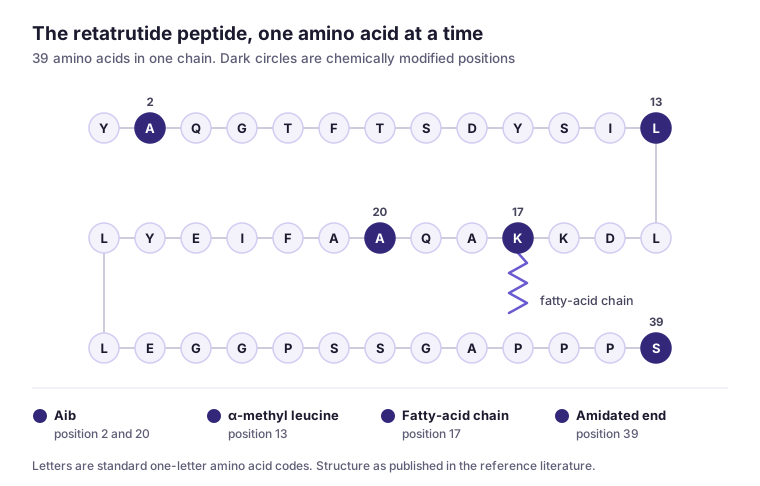
Plain letters are ordinary amino acids. 5 positions are not ordinary:
| Position | Change | What it is |
|---|---|---|
| 2 | Aib | 2-aminoisobutyric acid, an amino acid not among the 20 the body uses to build proteins |
| 13 | α-methyl leucine | Leucine with an extra methyl group |
| 17 | Fatty-acid chain | Lysine carrying a linker and a 20-carbon fatty diacid, which lets the peptide bind albumin in the blood |
| 20 | Aib | 2-aminoisobutyric acid, as at position 2 |
| 39 | Amidated end | Serine with its acid end capped as an amide |
Two of those changes, at positions 2 and 20, use an amino acid called Aib that your body never puts into its own proteins. The chain is not something a cell would make. It is a designed molecule that borrows the shape of three hormones at once.
The fatty-acid chain at position 17
This is the change that turns a short-lived hormone copy into a weekly drug. A 20-carbon fatty acid hangs off the chain on a flexible linker. In the blood, it latches loosely and reversibly onto albumin, the most common protein in plasma. Riding on albumin slows how fast the body clears it, so the peptide circulates for days instead of minutes.
Why the retatrutide peptide lasts a week
The phase 1 study, published in The Lancet in 2022, measured it directly. Retatrutide's half-life was about 6 days. Half of a dose is still circulating almost a week after the injection, and the paper concluded the numbers suited once-weekly dosing.
The discovery paper in Cell Metabolism found something more striking. In a phase 1 study, weight stayed lower than at the start for up to 43 days after a single dose. One injection, an effect lasting six weeks. I find that the most useful single fact for understanding why the trials could use a weekly schedule, and also why the dose has to be raised slowly: what you inject this week is still partly there next week.
One peptide, three receptors
It would have been simpler to mix three drugs. Lilly did not. The Lancet paper describes retatrutide as a single peptide with activity at all three receptors, so one chain carries the whole effect.
The balance between the three is not equal. In laboratory tests, its activity at the glucagon and GLP-1 receptors was balanced, with more activity at the GIP receptor. In obese mice, the same paper reports that adding the glucagon effect raised energy use on top of the reduced eating driven by the other two receptors. Those are laboratory and animal findings. The human trials measured weight, not which receptor did what. For how the three hormones work on appetite and blood sugar, see what retatrutide is.
Why the retatrutide peptide is injected, not swallowed
The stomach and gut are built to break proteins and peptides into single amino acids. Swallow an unprotected peptide and most of it is digested like food before it reaches the blood. That is why every retatrutide trial, from phase 1 to the 338-person phase 2 study and the phase 3 programme, has given it as a once-weekly injection under the skin.
It is not impossible to make a peptide pill. Rybelsus, sold in Canada, is semaglutide in tablet form. It is taken every day, on an empty stomach, with strict rules about water and food around the dose, because so little of a swallowed peptide gets through. No oral retatrutide has been tested in late-stage trials, so for now the drug is an injection.
How the retatrutide peptide is made
Retatrutide is assembled by chemists, not grown in cells. The method is called solid-phase peptide synthesis. Amino acids are added one at a time to a chain anchored on tiny resin beads. The finished chain is cut loose and purified, and the fatty-acid chain is added as part of the process.
Here is why that detail matters to a reader in Canada. Once a structure is published, the method is open to anyone with a synthesis lab. That is my inference, but it fits what regulators describe: a supply of unauthorized peptides made outside any approved manufacturing system. The difficult part is not getting a chain of roughly the right letters. It is proving the product is the right molecule, at the stated amount, without harmful leftovers from synthesis, and sterile enough to inject. That proof is what drug authorization checks.
What "research peptide" really means
On shop websites, "research peptide" is a label stuck onto products that are clearly marketed to people who want to inject them. It usually comes with a disclaimer that the vial is not for human consumption. The label exists to make an unauthorized drug sound like a lab reagent.
Health Canada does not accept that framing. Its April 9, 2026 advisory on peptides bought online named retatrutide and stated that a "research use only" label does not make a product legal. The full rules, the import position and a quick way to check any medicine are on our page about buying retatrutide in Canada.
Why the trial results do not transfer to a vial
Every number in the retatrutide trials, on weight and on side effects, belongs to a product made to a controlled specification and given at known doses. A vial from a website shares a name and, at best, a target structure. If its contents differ in identity, amount or purity, the trial data says nothing about what it will do. The word "peptide" on the label does not close that gap.
Peptides and the law in Canada
The rule is short. In Canada, injectable peptides are regulated as prescription drugs, and each one has to be authorized by Health Canada before it can be sold. Retatrutide is not authorized.
Enforcement has been stepping up. On July 29, 2026, Health Canada announced that the Superior Court of Québec had granted it a permanent injunction against Canlab Research, an online seller of unauthorized injectable peptides. The order bars the company from making, testing, distributing, selling or advertising them, including through websites and social media reachable from Canada. Health Canada said it had taken repeated action against the company before going to court.
That case covered unauthorized peptides as a whole, not retatrutide alone. It shows where the line sits for the whole category, and that the line is being enforced.
Retatrutide next to the other peptide drugs
Retatrutide is not a strange new kind of medicine. It belongs to a family of peptide drugs that Canadians already take on prescription.
- Insulin is a peptide hormone and has been injected for a century.
- Semaglutide, in Ozempic and Wegovy, is a peptide that copies one gut hormone and is injected weekly. As Rybelsus it is also a daily tablet.
- Tirzepatide, in Mounjaro and Zepbound, is a peptide that copies two.
What sets retatrutide apart is the third receptor, not the fact that it is a peptide. And the difference between it and those drugs, for now, is that they have each passed a Health Canada review and it has not.
What to take from all this
The retatrutide peptide is a carefully engineered molecule with a published structure, a measured half-life and a large body of trial evidence behind it. The "retatrutide peptide" sold online borrows that reputation without any of the checks that produced it. Both are called the same thing. Only one has been tested.
If you are following the real drug, the retatrutide approval timeline shows how far it is from a Canadian pharmacy, and the pages on side effects and dosage cover what the trials recorded.
Common questions
Is retatrutide a peptide?
Yes. Retatrutide is a single peptide, a chain of 39 amino acids with a fatty-acid chain attached. The phase 1 paper in The Lancet describes it as one peptide with activity at the GIP, GLP-1 and glucagon receptors.
How many amino acids are in retatrutide?
39. 5 of the positions are chemically modified, including two that use an amino acid the body does not build proteins from, and one that carries the fatty-acid chain.
How long does retatrutide stay in the body?
Its half-life was about 6 days in the phase 1 study, meaning half of a dose is gone after roughly 6 days. That is what makes once-a-week injections possible.
What is a “research peptide”?
It is a selling label, not a type of drug. Websites use it for vials of unauthorized peptides, usually with a line saying the product is not for human use. Health Canada has said that label does not make a product legal to sell.
Is retatrutide peptide legal in Canada?
It is not legal to sell. In Canada, injectable peptides are regulated as prescription drugs and must be authorized by Health Canada first, and retatrutide has not been. The rules on buying and importing are covered on our buying page.
Is there a retatrutide pill?
Not in the phase 3 programme. Every trial so far has injected it under the skin. Peptides are broken down in the gut, so a tablet would need extra engineering, and none has been tested in late-stage trials.
Sources
- LY3437943, a novel triple GIP, GLP-1, and glucagon receptor agonist in people with type 2 diabetes: a phase 1b, multicentre, double-blind, placebo-controlled, randomised, multiple-ascending dose trial. The Lancet, October 2022.
- LY3437943, a novel triple glucagon, GIP, and GLP-1 receptor agonist for glycemic control and weight loss: From discovery to clinical proof of concept. Cell Metabolism, August 2022.
- Triple-Hormone-Receptor Agonist Retatrutide for Obesity: A Phase 2 Trial. New England Journal of Medicine, June 2023.
- Retatrutide (chemistry section: amino acid sequence and modifications). Wikipedia, October 2026.
- Health Canada obtains permanent injunction preventing Canlab Research’s illegal sale of injectable peptides in Canada. Health Canada, July 2026.
- Think twice before injecting peptides bought online: unauthorized products can seriously harm you. Health Canada, April 2026.
- Rybelsus (semaglutide tablets) Product Monograph. Novo Nordisk Canada Inc., December 2025.