Awaiting pharmacist review. This page reports clinical trial results, and a licensed Canadian pharmacist has not read it yet. The sources for each number are listed at the foot of the page. It is not a basis for a treatment decision.
Retatrutide dosage in the phase 3 trials came in three strengths: 4 mg, 9 mg or 12 mg, injected once a week. Nobody started there. Participants began at 2 mg and stepped up every 4 weeks. No approved dose exists in Canada or anywhere else, so this page reports what the trials did. It is not a schedule to follow.
Is there an approved retatrutide dose?
No. A dose becomes official when a regulator authorizes the drug and signs off on its product monograph. That has not happened in any country. So there is no starting dose a doctor can prescribe, no list of pen strengths, and no instruction for a missed week.
What exists is the trial protocols. Those are the best preview of a future label, and they are still only a preview. Regulators sometimes approve fewer strengths than a company tested, or a different schedule for stepping up.
The retatrutide doses tested so far
| Trial | Adults | Weeks | Weekly doses tested |
|---|---|---|---|
| Phase 2 obesity trial | 338 | 48 | 1, 4, 8 and 12 mg |
| TRIUMPH-1 | 2,339 | 80 | 4, 9 and 12 mg |
| TRIUMPH-2 | 1,152 | 80 | 4, 9 and 12 mg |
| TRIUMPH-3 | 1,949 | 80 | 9 and 12 mg |
| TRIUMPH-4 | 445 | 68 | 9 and 12 mg |
Two patterns are worth a look. The phase 2 trial went as low as 1 mg, and phase 3 dropped that dose. And two of the four phase 3 trials skipped 4 mg, so what we know about the lowest dose comes from TRIUMPH-1 and TRIUMPH-2.
Retatrutide dose and weight loss: what each step added
Here is the question behind most dosage searches: does more drug mean more weight lost? TRIUMPH-1 gives the cleanest answer, because it tested all three doses in 2,339 adults for 80 weeks.
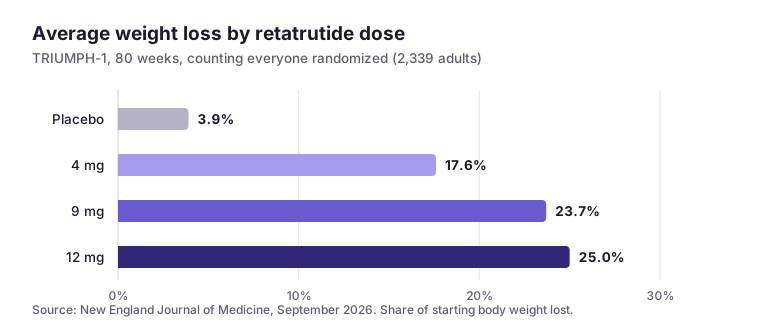
| Average weight loss | Placebo | 4 mg | 9 mg | 12 mg |
|---|---|---|---|---|
| TRIUMPH-1, 80 weeks | 3.9% | 17.6% | 23.7% | 25.0% |
| TRIUMPH-2, 80 weeks | 5.1% | 11.9% | 16.8% | 18.8% |
Both rows come from the journal papers and count everyone randomized, including people who stopped the drug early. Now look at the size of each step in TRIUMPH-1.
- From 4 mg to 9 mg: 6.1 more percentage points of weight loss.
- From 9 mg to 12 mg: 1.3 more.
The first step is worth almost five times the second. TRIUMPH-2, in adults with type 2 diabetes, shows the same shape with smaller numbers: 4.9 points for the first step and 2.0 for the second.
The phase 2 trial saw the same plateau
| Phase 2 dose | Week 24 | Week 48 |
|---|---|---|
| Placebo | 1.6% | 2.1% |
| 1 mg | 7.2% | 8.7% |
| 4 mg | 12.9% | 17.1% |
| 8 mg | 17.3% | 22.8% |
| 12 mg | 17.5% | 24.2% |
At 24 weeks the 8 mg and 12 mg groups were almost level, at 17.3% and 17.5%. By 48 weeks the gap had opened to 1.4 points. That trial had 338 participants split across seven groups, so each group was small.
My opinion, for what it is worth: the top dose looks like a small gain for a real cost. In TRIUMPH-1, 6.9% of people on 9 mg stopped for an adverse event and 11.3% did on 12 mg. Our retatrutide side effects page has the full breakdown.
Retatrutide 9 mg vs 12 mg: the same comparison in four trials
One trial can mislead. So here is the top-two comparison in every phase 3 trial that has reported.
| Trial | 9 mg | 12 mg | Extra from 12 mg | Basis |
|---|---|---|---|---|
| TRIUMPH-1 | 23.7% | 25.0% | 1.3 points | Journal paper |
| TRIUMPH-2 | 16.8% | 18.8% | 2.0 points | Journal paper |
| TRIUMPH-3 | 21.6% | 22.6% | 1.0 points | Lilly topline |
| TRIUMPH-4 | 20.0% | 23.7% | 3.7 points | Lilly documentation |
In three of the four, the higher dose added two points or less. TRIUMPH-4 is the exception, and it is also the smallest trial, with 445 participants. A regulator will have the full data to weigh this. From the outside, 9 mg looks like the dose doing most of the work.
The retatrutide dosing schedule: how the trials stepped up
Nobody in these trials began on their final dose. Lilly's documentation for TRIUMPH-4 describes the schedule in one line: start at 2 mg, then raise the dose every 4 weeks until reaching the assigned target of 9 mg or 12 mg.
Here is why the climb is slow. The phase 2 trial tested the starting dose on purpose. Some people began at 2 mg and others at 4 mg, on the way to the same target. Stomach and bowel side effects were dose-related, mostly mild to moderate, and partly reduced by starting at 2 mg instead of 4 mg.
The sources I checked do not list each rung of the ladder between 2 mg and 12 mg, so I am not going to print one. Schedules circulating online that show exact weekly amounts are either taken from documents I could not verify or made up.
How long the climb takes
With steps 4 weeks apart, reaching a high target dose takes months, not weeks. That matters when you read the results. Weight loss measured at 80 weeks includes the long stretch people spent on lower doses on the way up.
When the trials allowed a lower retatrutide dose
The rule in TRIUMPH-4 was strict. Dose reductions were allowed only during the escalation phase, for stomach and bowel side effects, or for participants who reached a BMI of 22 or lower or felt they were losing too much weight.
Read the last part of that rule again. The protocol expected that some people would lose more weight than they wanted, and it wrote in a way to slow down. That is a striking thing to find in an obesity drug protocol, and it says something about how strong the effect can be.
How retatrutide is taken
Retatrutide is given as a once-weekly injection under the skin. In TRIUMPH-2, participants gave themselves the injections. Lilly has not announced what the commercial device will be, how many strengths it will come in, or how it will be stored. Those details arrive with a product monograph, and there is none yet.
Retatrutide maintenance dose: the open question
Every result so far measures weight loss while the dose is climbing or holding at its target. What nobody has published is what happens next. Do people stay on 12 mg for good? Can they drop to a lower dose and keep the weight off?
TRIUMPH-6 is the trial built to answer that. It enrolled 643 adults, 8 of its sites are in Canada, and the registry estimates its main data collection ends in April 2028. It is no longer recruiting.
Until it reports, the 4 mg result is the most interesting hint. In TRIUMPH-1 that dose produced a 17.6% average weight loss, and fewer people stopped it for an adverse event than stopped placebo. A dose that mild could turn out to be where long-term treatment settles. That is my guess, not a finding.
Why online retatrutide dosage charts are not dosing guidance
Search for a retatrutide dose and you will find charts that convert milligrams into syringe units. They look precise. They rest on one assumption: that the vial holds exactly what its label claims.
No one has verified that for any retatrutide sold online. Health Canada has not assessed those products, and its 2026 advisory on injectable peptides names incorrect dosing as one of the risks. If the starting amount is unknown, the arithmetic on top of it is too.
That is why you will not find mixing volumes or unit conversions here. The details on what those products are, and where the law stands, are on our page about buying retatrutide in Canada.
What we still do not know about retatrutide dosing
- Missed doses. No published guidance says what to do after a skipped week.
- Switching. I found no published result on moving from semaglutide or tirzepatide to retatrutide.
- Kidney and liver disease. Trials in people with kidney disease and fatty liver disease exist, and no dosing guidance has come out of them yet.
- The final label. Health Canada could authorize a different set of strengths than the trials used.
Dosing questions to ask once retatrutide has a real label
None of these has an answer today. They are the ones I would want settled before a first injection.
- Which strengths did Health Canada authorize, and is 4 mg one of them?
- How many weeks does the label require at each step before moving up?
- Is staying on a lower dose for good an approved choice, or only a stop on the way?
- What does the label say to do after one missed injection, and after several?
- Does my kidney or liver function change the dose?
What a Canadian prescriber will work from
When Health Canada authorizes a drug, it publishes a product monograph with the official dosing section. A pharmacist counsels from that document. For retatrutide it does not exist, and it cannot exist until a submission is filed, reviewed and approved.
Next steps: the retatrutide approval timeline tracks how far away that is. If you want the background on how the drug works, start with what retatrutide is. And if you are choosing a dose of a medicine that is authorized in Canada today, that is a conversation for your own prescriber.
Common questions
What is the retatrutide dosage used in trials?
The phase 3 trials tested 4 mg, 9 mg and 12 mg, each injected once a week. The earlier phase 2 trial tested 1, 4, 8 and 12 mg. None of these is an approved dose, because no regulator has approved retatrutide.
What is the starting dose of retatrutide?
In TRIUMPH-4, participants started at 2 mg and stepped up every 4 weeks until they reached their assigned dose. The phase 2 trial compared starting at 2 mg with starting at 4 mg, and the lower start produced fewer stomach and bowel side effects.
What is the highest retatrutide dose?
12 mg once a week is the highest dose tested in phase 3. In TRIUMPH-1 it produced an average 25.0% weight loss at 80 weeks, counting everyone randomized, against 23.7% at 9 mg.
How often is retatrutide taken?
Once a week, as an injection under the skin. Every phase 2 and phase 3 trial used that schedule.
Does a higher retatrutide dose mean more weight loss?
Yes, with shrinking returns. In TRIUMPH-1, going from 4 mg to 9 mg added 6.1 percentage points of average weight loss. Going from 9 mg to 12 mg added 1.3.
Is the retatrutide dose the same for everyone?
In the trials, no. Participants were assigned at random to a target dose, and the 4 mg, 9 mg and 12 mg groups ran side by side. Which dose a patient would be given outside a trial is a question for a future label and a prescriber.
Can I use a retatrutide dosage chart I found online?
Those charts assume the vial holds exactly what its label says. Nobody has checked that for products sold online, and Health Canada lists incorrect dosing among the risks of unauthorized peptides. A chart cannot fix an unknown starting point.
Sources
- Retatrutide, a Triple Hormone Receptor Agonist, for Treatment of Obesity. New England Journal of Medicine, September 2026.
- Retatrutide in adults with obesity and type 2 diabetes (TRIUMPH-2): a double-blind, parallel-group, randomised, placebo-controlled, phase 3 trial. The Lancet, September 2026.
- Triple-Hormone-Receptor Agonist Retatrutide for Obesity: A Phase 2 Trial. New England Journal of Medicine, June 2023.
- What are the preliminary results with retatrutide from TRIUMPH-4 in participants with obesity or overweight and osteoarthritis?. Lilly Medical, Eli Lilly and Company, August 2026.
- Lilly’s triple agonist, retatrutide, delivered powerful weight loss in pivotal Phase 3 obesity trial. Eli Lilly and Company, May 2026.
- Retatrutide studies with sites in Canada (registry search). ClinicalTrials.gov, U.S. National Library of Medicine, October 2026.
- Think twice before injecting peptides bought online: unauthorized products can seriously harm you. Health Canada, April 2026.